
Generative AI tools are making their way into SOX compliance, automating many tasks like documentation, control testing, and issue analysis. This has sparked debate about whether AI could one day replace SOX consultants. A more productive question is: what can SOX professionals do now to ensure they remain indispensable in an AI-augmented future? The answer lies in focusing on the uniquely human skills and strategic actions that AI cannot replicate.
The AI Revolution in SOX Compliance
In high-pressure compliance situations, AI-driven solutions have already demonstrated impressive capabilities. For example, an AI tool can produce a SOX gap assessment with detailed remediation plans in seconds, automatically mapping financial statement line items to corresponding controls and test results, cross-referenced against PCAOB standards, SEC guidance, and peer benchmarks. This kind of speed and thoroughness is undeniably appealing to executives, and the promise of AI-driven compliance can seem nearly bulletproof.
AI tools today are increasingly capable of handling tasks that once consumed significant human resources: routine control testing, data analysis, and documentation preparation. However, this impressive capability masks a more complex reality. While generative AI can automate many aspects of SOX program management, control assessment, and testing, human judgment remains essential—especially for nuanced risk decisions and context-specific exceptions that AI cannot fully grasp.
The Empathy Gap: What AI Cannot Replicate
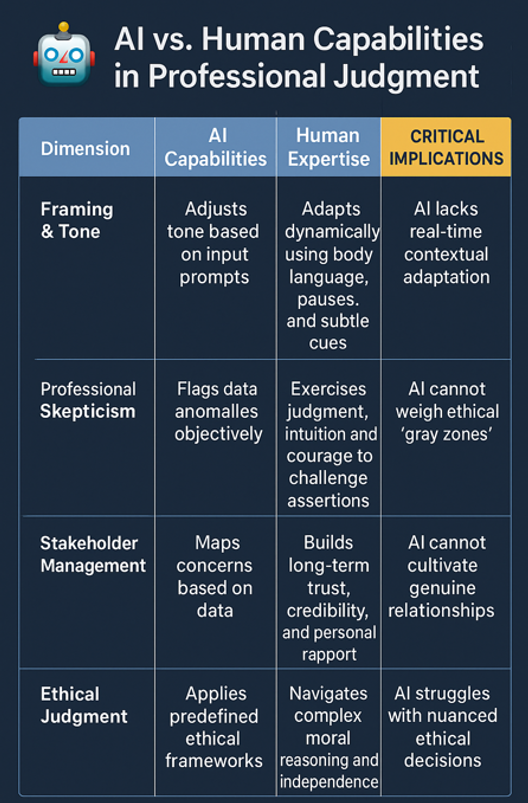
Can ChatGPT—or any AI—truly be trained to persuade, empathize, and adapt with enough nuance to convince skeptical, overburdened control owners to embrace significant increases in control activities? The research reveals fundamental limitations. AI excels at data-driven analysis, yet struggles in situations involving subjective judgment, sparse data, or nuanced contexts that require human judgment, relationships, and ethics. Researchers note several human capabilities that AI cannot fully replicate: empathy, interpersonal presence, moral judgment, creativity, and genuine human connection. All of these are critical in SOX remediation, where relationship management and strategic insight are paramount.
Studies have found that AI-generated responses can sometimes seem more compassionate than human ones in controlled experiments, but that’s typically only in text-based, anonymous interactions. In reality, effective SOX consulting requires face-to-face relationship-building, reading nonverbal cues, and adapting to complex organizational dynamics in real time—none of which AI can handle. AI might simulate cognitive empathy (understanding emotions from data), but it cannot experience or convey emotional empathy or genuine compassion. This gap becomes critical when navigating the resistance, fatigue, and competing priorities that characterize many SOX remediation efforts.
Persuasion in auditing is an art cultivated through patience, empathy, and respect—qualities beyond the reach of any algorithm. The most obvious limitation of using AI in the audit setting is that AI cannot easily replace social interaction among auditors. Even the most advanced tools cannot eliminate the human element. Successful remediation depends on the collaboration of control owners and the willingness of external auditors to entertain workable compromises. Plans must be not only compliant, but feasible, sustainable, and pragmatic.
While AI can rapidly perform a SOX diagnostic, its output often mirrors the limitations of the checklists it is trained on—binary conclusions, template-driven assessments, and little ability to look beyond the prescribed control description. What AI cannot yet replicate is the consultant’s ability to probe deeper: asking nuanced questions that uncover undocumented practices, recognizing when a monitoring activity can serve as an effective compensating control, and using judgment to distinguish true gaps from issues of form rather than substance. Experienced consultants bring context, skepticism, and creativity to the diagnostic process—skills that often transform a simple “gap” into a viable, sustainable solution. In areas where risk is complex and human behavior shapes control execution, this blend of expertise and insight remains essential, even in an AI-enabled world.
Consider another practical dimension: the human side of SOX compliance. Firing an uncooperative control owner might seem like a decisive fix, but PCAOB standards require reassessing the new owner’s competence, re-performing walkthroughs, and re-testing controls. The result is more cost, more risk, and more delay. Technical accuracy is only half the equation; human persuasion, cooperation, and change management often determine whether remediation succeeds. These are precisely the areas where consultants—and not algorithms—add irreplaceable value. While AI can mimic the form of empathy, it struggles to embody its substance. The real test of persuasion in SOX remediation is not whether a message is phrased gently, but whether it convinces fatigued control owners, skeptical CFOs, or external auditors with competing priorities.
The Training Transformation: What’s Changing
The implications for professional development are profound. AI is reshaping training needs, careers, risks and policies, requiring a fundamental shift in how SOX professionals prepare for their roles. Consider two training scenarios: In the past, a junior auditor might spend weeks learning to manually trace revenue recognition through multiple systems and document the findings in standardized templates. Today, AI can perform this tracing and generate draft documentation in hours. The training emphasis shifts from how to trace transactions to how to explain to a defensive CFO why an AI-flagged exception indicates a potential material weakness—a conversation requiring empathy, credibility, and negotiation skills no algorithm can teach.
The evidence points toward a bifurcated training landscape. Organizations should:
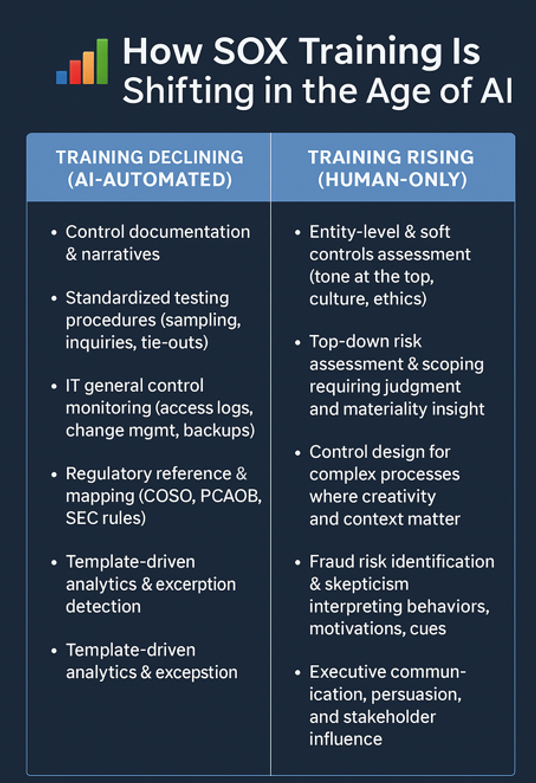
- Reduce emphasis on technical training that AI can automate: routine documentation, standardized testing procedures, and memorization of regulatory standards.
- Intensify focus on uniquely human capabilities: communication skills, ethical reasoning, professional skepticism, and stakeholder management.
- Develop hybrid competencies: teaching professionals how to effectively collaborate with AI tools while maintaining critical oversight and professional judgment.
In practice, many formerly critical audit tasks (e.g. writing control narratives, performing standard test procedures, monitoring IT logs, or researching regulatory guidance) can now be offloaded to AI tools. Conversely, tasks that demand insight, creativity, and interpersonal skills—such as evaluating soft controls and corporate culture, scoping and designing controls for complex or unusual processes, identifying potential fraud risks, and communicating findings to executives—are becoming even more important for professionals to master.
The Soft Skills Premium
AI has the potential to save firms 18 hours per month per employee, with advanced users saving 71% more time than basic users. However, this efficiency gain amplifies rather than eliminates the need for sophisticated human skills. As AI handles routine tasks, SOX professionals must excel in areas where human judgment remains irreplaceable:
- Influence & Persuasion: Building buy-in from management and mediating auditor–process owner disagreements through authentic relationship-building.
- Executive Presence: Presenting findings to senior leadership with confidence, credibility, and the ability to read the room and adjust in real time.
- Negotiation & Conflict Management: Handling resistance to costly or disruptive remediation efforts while preserving professional relationships.
- Ethical Leadership: Challenging management assertions diplomatically and recognizing when something “doesn’t feel right” in sensitive contexts.
- Change Management: Going beyond compliance checking to act as a trusted advisor who guides the organization through change.
Other domains of expertise—from maintaining audit independence and understanding organizational culture to crisis management and adapting to emerging risks—also remain firmly in human hands. The more complex or sensitive the situation, the more essential human judgment becomes.
Preparing for the AI-Augmented Future: Five Actions for CAEs and Audit Leaders
While the largest audit firms and Fortune 500 companies are rapidly deploying AI tools, smaller organizations face different timelines. Yet the fundamental shift in required skills remains universal—whether your firm adopts AI today or in three years, the premium on human judgment and empathy will only grow. Internal audit leaders should take these concrete steps now:
- Audit Your Team’s Skill Gaps: Assess current capabilities in soft skills versus technical competencies. Identify team members who excel at stakeholder management versus those stronger in technical documentation.
- Invest in Communication Training: Prioritize training in influence, persuasion, executive presence, and conflict resolution for senior staff. These skills will differentiate high-value auditors from those merely executing AI-driven test plans.
- Pilot AI Tools Strategically: Begin with routine documentation and standardized testing while maintaining rigorous quality oversight. Use early pilots to identify where human judgment remains critical.
- Create Hybrid Mentorship Programs: Pair technical AI proficiency with judgment development. Ensure junior staff learn both how to leverage AI tools and when to override them based on professional skepticism.
- Revise Performance Evaluations: Place greater emphasis on relationship management, stakeholder influence, and ethical judgment in performance evaluations. Recognize and reward the unique human contributions that AI cannot replicate.
AI is poised to be a powerful ally in SOX compliance, accelerating testing and analysis in ways that were unimaginable just a few years ago. But its limits are equally clear: capabilities like professional skepticism, nuanced negotiation, and genuine empathy remain uniquely human. The question isn’t whether AI will transform the audit profession—it will—but whether professionals can transform themselves to leverage AI while deepening the human expertise that machines can’t replace. Those who master this balance will find that AI doesn’t replace them – it amplifies their effectiveness.
In the end, AI is not a threat to SOX consultants but a tool. The future belongs to those who recognize that technology can take over the repetitive, manual, low-judgment tasks, freeing humans to focus on insight, judgment, and relationships. As we enter this AI-augmented era of auditing, the technology may steal a few scenes, but the standing ovation will still go to the auditors and consultants who blend digital speed with human intuition. Behind every control test and remediation plan is a real person balancing compliance with real-world pressures—and that’s something no algorithm will ever truly understand.